“Local Intent” refers to search queries where the user is specifically looking for information tailored to their immediate geographic environment.
For example, a user in Edinburgh searching for “best time to plant grass” faces a completely different climate challenge than a user in Southampton. If you write a generic article based on national averages, you provide little value. If you write “The exact week to plant grass seed in Edinburgh (based on local frost dates),” you immediately become the most relevant authority for that user.
Google’s algorithms (including BERT and RankBrain) are trained to identify when a query implies a local need. Your content must explicitly signal to Google that it answers these specific local nuances better than a national competitor can.
The “Google Suggest” Mining Method
The most accurate source of local blog topics is Google’s own data. The autocomplete feature reveals exactly what local customers are typing in real-time.
The Strategy:
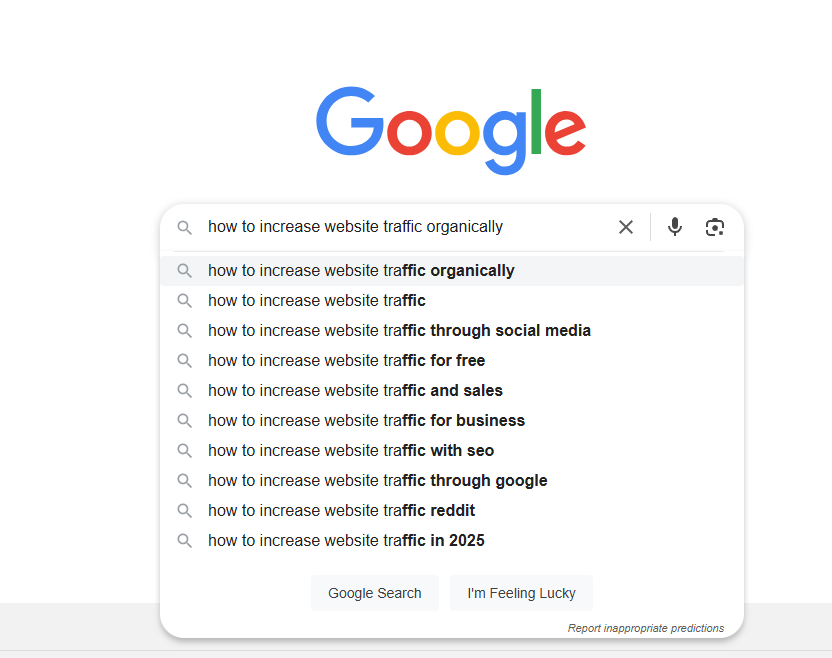
- Open an Incognito Window: This prevents your previous search history from skewing the predictions.
- Type your service + your city: e.g., “Landscaper Birmingham”.
- Do NOT press Enter: Watch the dropdown list.
- Add a letter: “Landscaper Birmingham p…”, “Landscaper Birmingham s…”.
You will uncover specific long-tail queries like:
- “Landscaper Birmingham prices” -> Blog Topic: “Cost of Garden Design in Birmingham: 2024 Price Guide”
- “Landscaper Birmingham small gardens” -> Blog Topic: “5 Design Ideas for Small Terraced Gardens in Birmingham”
- “Garden maintenance packages” -> Blog Topic: “What should be included in a monthly garden maintenance plan?”
The “Local Resource” Content Strategy
To build authority, you must become a helpful resource for your specific community, addressing local regulations, geography, or climate issues that national competitors ignore.
Examples for a Local Business:
- Topic: Local Regulations
- Title: “Do you need planning permission for a 2-metre fence in [City] conservation areas?”
- Why: This targets homeowners in specific historic districts who are ready to buy but worried about the council.
- Topic: Local Climate/Environment
- Title: “The best plants that thrive in [City]’s clay soil.”
- Why: It positions you as the expert who understands the specific “pain points” of the local terrain.
- Topic: Local Events
- Title: “Getting your garden ready for the [City] Summer Festival.”
- Why: Tying your service to a known local event creates immediate timeliness and relevance.
Competitor Gap Analysis
Your local competitors are likely targeting keywords you have missed. You can legally analyze their content strategy to find gaps in your own.
The Strategy:
- Identify Top 3 Competitors: Search for your main service in your city (e.g., “Solicitors in Leeds”) and note who ranks #1, #2, and #3 in the organic results.
- Scan Their Blog: Look for their “News” or “Insights” section.
- Analyse Titles: Are they writing about “Divorce Law”? “Commercial Leases”? “Will Writing”?
- Improve It (The Skyscraper Technique): If they have a short 500-word post on “Writing a Will,” write a 1,500-word “Complete Guide to Will Writing in Leeds,” including local probate office details and FAQs.
Using “People Also Ask” (PAA)
The “People Also Ask” box in search results is a direct feed of user questions.
The Strategy:
- Search: “[Service] [City]” (e.g., “Roofers Manchester”).
- Scroll: Locate the “People also ask” box mid-way down the page.
- Click: Click on a question to expand it. Critically, when you close it, 2-3 new questions will appear below it.
- Mine: Keep clicking until you have a list of 10–20 hyper-relevant questions.
- Example: “How much does a new roof cost in the UK?”
- Example: “Can I replace my own roof tiles?”
- Example: “Is it illegal to not fix a leaking roof?”
Answering these questions in a blog post (e.g., “The Truth About Roof Replacement Costs in Manchester”) guarantees you are answering a question real users are asking.

 Salesforce